
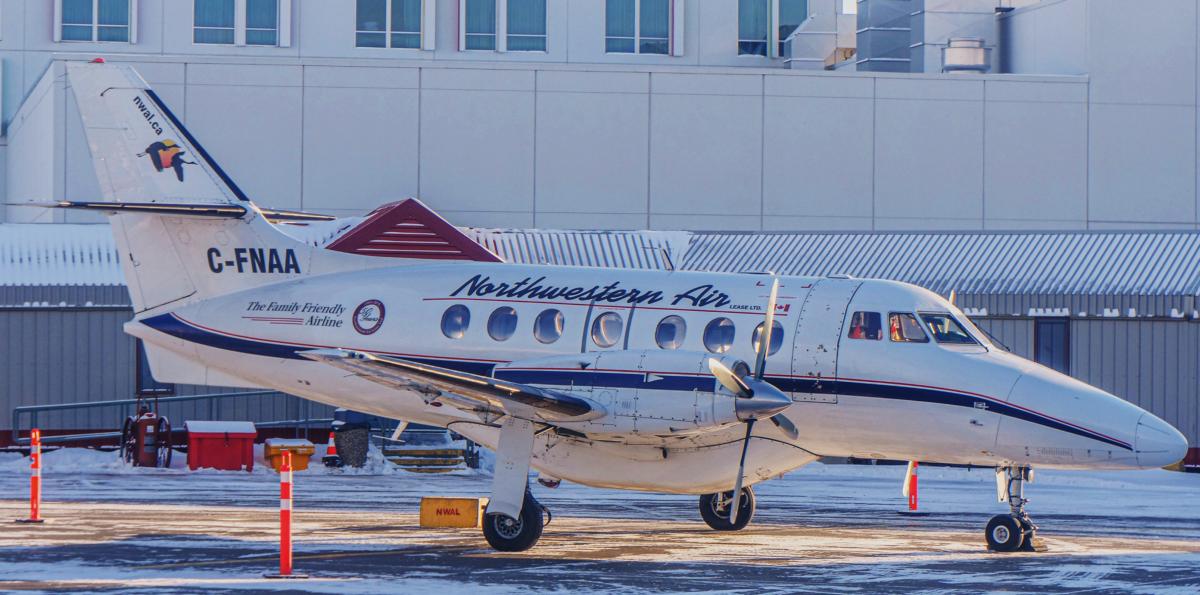
Six people aboard a commuter aircraft were killed near Fort Smith, Northwest Territories, after a captain deliberately flew a shallow takeoff to shed snow from the wings — a decision that set off a chain of events ending in a crash, a federal investigation has found.
The Transportation Safety Board of Canada released its report into the January 23, 2024, crash of a Northwestern Air Lease Ltd. British Aerospace Jetstream 3212 on March 5, 2026. The captain, first officer, and four of five passengers died. One passenger survived after being ejected from the aircraft during the crash sequence.
The aircraft departed Fort Smith Airport under instrument flight rules — meaning pilots navigate by instruments rather than visual cues — bound for the Diavik Diamond Mine with two crew and five passengers aboard.
What went wrong on takeoff
Snow was falling when the crew prepared for departure in darkness. Concerned about accumulation on the wings, the captain kept the aircraft’s nose low and speed high after liftoff to blow the snow off.
That non-standard climb put the aircraft far closer to the ground than normal. When the crew raised the landing gear, the combination of temperatures colder than approximately minus 20 degrees Celsius and high airspeed prevented one main gear unit from locking in the retracted position.
The first officer called for the captain to reduce speed so the gear could retract. The captain cut engine power. The aircraft began descending from a maximum height of roughly 140 feet above ground level.
Both crew members were focused on the landing gear problem and airspeed. Neither noticed the aircraft losing altitude until seconds before impact. The plane struck trees 0.5 nautical miles past the runway end and hit the ground 0.6 nautical miles out. Ten seconds passed between the start of the descent and impact. A post-impact fire destroyed most of the aircraft.

A known problem that was never written down
The investigation found a significant organizational failure beneath the sequence of events: every pilot assigned to fly the Jetstream at Northwestern Air Lease knew the left main landing gear sometimes failed to retract fully in cold temperatures and at high speed — yet no one had ever recorded it in the aircraft’s technical log.
The company’s own operations manual required pilots to log all defects after every flight. The board found the gear problem had been present for months and that maintenance staff were aware of it but could not replicate it in the hangar because it only appeared in specific flight conditions.
The Transportation Safety Board identified this as a systemic risk. If pilots do not record defects in technical records, maintenance personnel cannot address them — and aircraft may be sent into service in an unsafe condition.
An informal fix that became standard practice
Rather than following the aircraft manufacturer’s abnormal checklist — which directs pilots to lower the gear and land at the nearest suitable airport — crews at Northwestern Air Lease had developed their own workaround: pitch up, bleed off speed below 140 knots indicated airspeed, and the gear would lock into place.
The procedure worked consistently enough that pilots stopped seeing it as a deviation. It was never written into company procedures or formally approved. The board found this normalization of an informal fix eroded safety margins and reduced the effectiveness of crew coordination.
The manufacturer’s checklist existed specifically to address the gear-not-locked situation. The board found that historically, pilots at the company did not consult it when the warning light appeared.

Monitoring roles were not clearly defined
The board also identified a gap in how Northwestern Air Lease defined crew responsibilities during departure. The company’s standard operating procedures did not spell out what the pilot monitoring — the crew member not flying the aircraft — was specifically responsible for watching during takeoff and climb.
International aviation safety guidance recommends that operators clearly define monitoring roles for each pilot in writing. When those roles are vague, both crew members may focus on the same problem and miss others — as appears to have happened here, when neither pilot caught the altitude loss in time.
What the company did afterward
Northwestern Air Lease amended its standard operating procedures for the Jetstream series aircraft in October 2024 to clarify how and when pilots must respond to abnormal and emergency situations. The company stopped scheduled service and Jetstream operations in January 2025.
The Transportation Safety Board is an independent agency that investigates occurrences in air, marine, pipeline, and rail transportation. It does not assign fault or determine legal liability.