
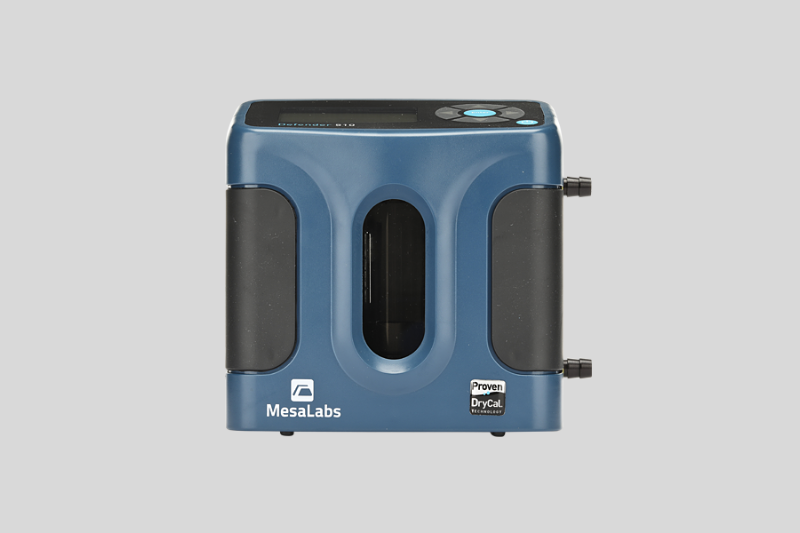
U.S. workplace safety regulators have standardized their field enforcement operations on Mesa Laboratories’ DryCal Defender calibrators, purchasing more than 120 units in 2025, as occupational health professionals warn that a generational knowledge gap is putting worker exposure monitoring at risk.
Mesa Labs, based in Lakewood, Colo., makes air sampling pump calibrators used to measure worker exposure to hazardous substances. OSHA and the National Institute for Occupational Safety and Health require calibrators to meet an accuracy standard of plus or minus one per cent. According to the company, a growing share of the market relies on secondary standard instruments that can drift to four to 20 per cent error at low flow rates — the conditions most critical to detecting harmful exposures.
Primary vs. secondary standards
The distinction between primary and secondary calibration standards sits at the heart of the issue. Primary standards measure gas flow directly from fundamental units of volume and time. Secondary standards derive flow measurements indirectly from pressure drop, temperature, and gas viscosity assumptions, which can introduce error.
Mesa’s DryCal technology uses a piston prover, a primary standard device. According to the company, if contamination enters the measurement cell, the piston stops moving before it can produce an inaccurate reading — a built-in fail-safe that secondary instruments do not offer.
“When a false low reading means a worker stays in a hazardous environment without protection, the instrument behind that measurement has to be beyond question,” said Zach Wright, head of sales for instruments at Mesa Labs. “Primary standards directly measure. Secondary standards only derive. That difference matters.”
Knowledge gap raises concern
Mesa staff product manager Ram Parameshwar said the profession is at a turning point as experienced industrial hygienists retire and are replaced by workers who may not fully understand calibration fundamentals.
“Experienced practitioners who understood the fundamental difference between primary and secondary standards are retiring in large numbers,” Parameshwar said. “The professionals replacing them are entering a market flooded with messaging that treats calibration as a box to check rather than the foundation of every exposure determination.”
Education initiative
Mesa Labs has partnered with the American Industrial Hygiene Association to offer a webinar titled “Flow Calibration Essentials for the OEHS Professional.” The session features Parameshwar alongside Laurence R. Durio, a certified industrial hygienist with more than 50 years of experience, including prior service with OSHA enforcement. A recording is available through the AIHA website.
The company says additional Defender unit orders from OSHA are planned for 2026.